
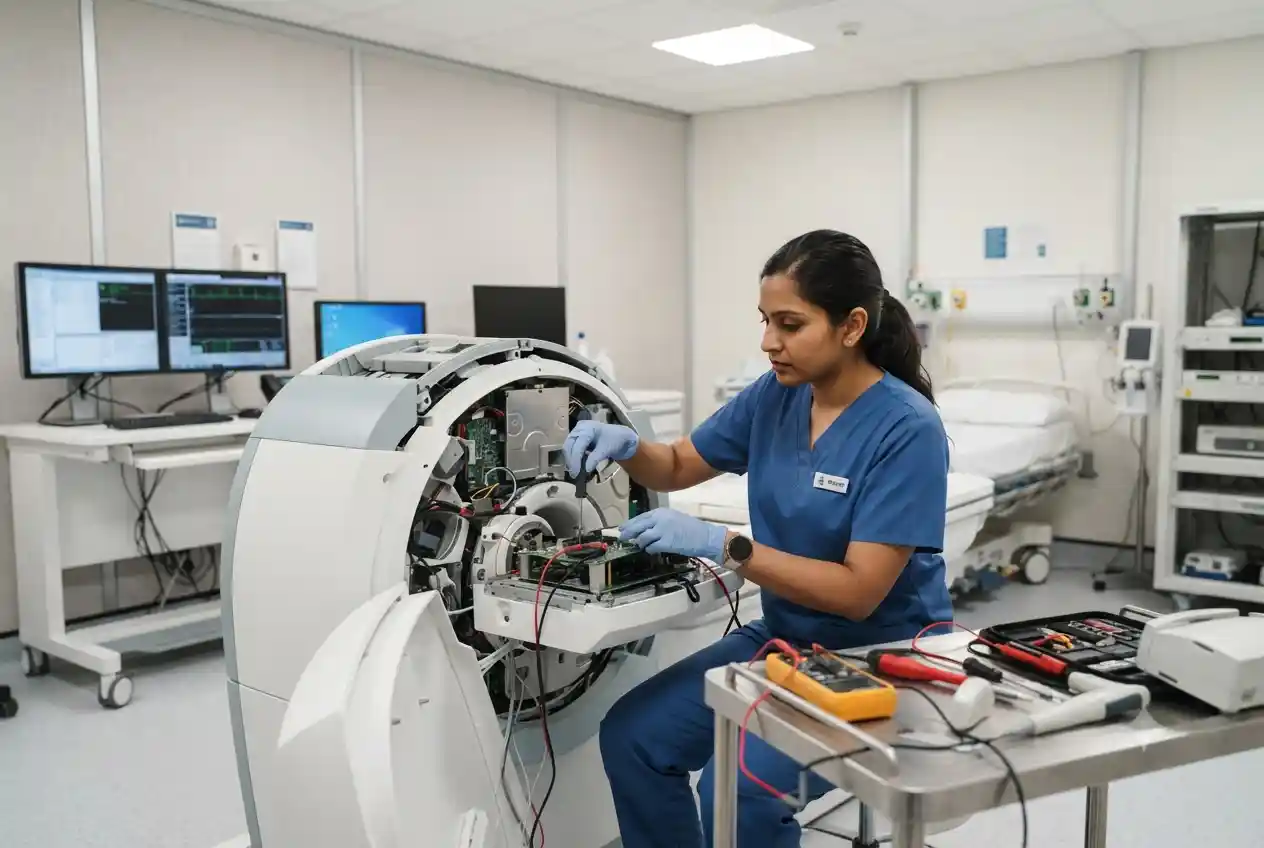

Modern technology medical equipment maintenance is a critical component of today’s healthcare systems. Hospitals, clinics, and diagnostic centers rely on advanced medical devices for accurate diagnosis, treatment, and patient monitoring. Ensuring that these devices function properly is essential for both patient safety and operational efficiency.
As healthcare technology becomes more sophisticated, maintenance services have evolved to include preventive care, system diagnostics, and integration with digital systems.
Why Medical Equipment Maintenance Is Essential
Patient Safety
Properly maintained equipment ensures accurate results and safe treatment procedures. Malfunctioning devices can lead to incorrect diagnoses or delays in care.
Operational Efficiency
Healthcare facilities depend on equipment availability. Regular maintenance reduces downtime and ensures that systems are always ready for use.
Regulatory Compliance
Healthcare providers must comply with strict regulations and standards. Maintenance helps ensure that equipment meets these requirements.
Cost Savings
Preventive maintenance reduces the risk of major breakdowns, minimizing repair costs and extending the lifespan of equipment.
Types of Medical Equipment Maintenance
Preventive Maintenance
This involves regular inspections, cleaning, and calibration to prevent potential issues. It is a proactive approach that ensures equipment remains in optimal condition.
Corrective Maintenance
Corrective maintenance addresses issues after they occur. This includes repairing or replacing faulty components to restore functionality.
Predictive Maintenance
Advanced technologies allow for predictive maintenance, where data and analytics are used to anticipate potential failures before they happen.
Calibration and Testing
Regular calibration ensures that equipment provides accurate readings, which is crucial for diagnosis and treatment.
Key Technologies Involved
Modern medical equipment maintenance relies on a combination of hardware and software systems.
High-quality components supplied by key technology equipment providers ensure reliability and performance.
IT integration, often supported by companies like future technologies llc and jupiter plus technology llc, enables real-time monitoring and diagnostics.
Additionally, system integration services from triple a technology solutions llc help connect medical devices with hospital information systems.
Role of Service Providers
Maintenance services are typically handled by specialized providers with expertise in biomedical engineering and healthcare technology.
These providers may collaborate with equipment suppliers such as omang technologies and trading llc to ensure access to genuine parts and components.
They also work with IT system providers like al mutawr al alamiah information technology systems to integrate maintenance processes with digital platforms.
Integration with Digital Healthcare Systems
Modern healthcare facilities use digital systems to manage patient data, appointments, and equipment performance. Integrating maintenance processes with these systems improves efficiency and transparency.
For example, automated alerts can notify technicians when equipment requires servicing, reducing the risk of unexpected failures.
Companies such as rama technology contribute to developing customized IT solutions that support these integrations.
Global Standards and Best Practices
Medical equipment maintenance must adhere to international standards to ensure safety and reliability. These standards cover aspects such as calibration, testing, and documentation.
Large engineering organizations like china national aero technology international engineering corporation highlight the importance of structured processes and quality control in technical operations.
Workforce and Training
Maintaining advanced medical equipment requires skilled professionals with expertise in biomedical engineering and technology.
Educational institutions such as the Sharjah Institute of Technology play a key role in training technicians and engineers who can handle complex systems.
Continuous training is essential to keep up with evolving technologies and industry standards.
Future Trends in Medical Equipment Maintenance
The future of maintenance is driven by innovation. Technologies such as artificial intelligence, IoT, and data analytics are transforming how equipment is monitored and serviced.
Predictive maintenance, remote diagnostics, and automated systems are becoming increasingly common, improving efficiency and reducing costs.
As healthcare systems continue to evolve, the demand for advanced maintenance services will grow, creating new opportunities for innovation and improvement.
Ending Note
Modern technology medical equipment maintenance is essential for ensuring the safety, reliability, and efficiency of healthcare systems. By combining technical expertise, advanced tools, and digital integration, maintenance providers help healthcare facilities deliver high-quality patient care.
Through collaboration with equipment suppliers, IT service providers, and educational institutions, the industry continues to evolve and meet the demands of modern healthcare.
Building a Maintenance Plan That Actually Works
A maintenance plan is more than a schedule pinned to a wall. It begins with a complete inventory of every device a facility owns, including its location, age, manufacturer guidance, and service history. Without this inventory, planning is guesswork: some devices get serviced twice while others are forgotten. Each device should have a named owner on the team, a clear service interval, and a record of every inspection, repair, and calibration. This record becomes invaluable when a device fails, when auditors ask for evidence, or when leaders decide whether to repair or replace ageing equipment.
Prioritisation is essential, because not all devices carry equal risk. Life-support and diagnostic equipment that directly affects treatment decisions deserves the most frequent attention, while lower-risk items can follow longer intervals. Manufacturers’ guidance provides the starting point, but real usage patterns matter too: a device used around the clock wears differently from one used occasionally. Facilities that plan well also budget for maintenance as a core cost, not an afterthought, since planned servicing is almost always cheaper than emergency repair. Background on the technology providers involved can be found in guides such as key technology equipment providers and global technology services.
Preventive, Predictive, and Corrective Maintenance in Practice
Preventive maintenance is the routine work that keeps devices in good order: cleaning, inspection, lubrication where appropriate, software updates, and replacement of parts that wear predictably. It is scheduled in advance and carried out whether or not a fault is visible, which is precisely the point. Corrective maintenance, by contrast, responds to a fault after it appears, and while it will always be needed, a facility that relies mainly on corrective work is usually one whose preventive programme has gaps. Tracking how much work falls into each category is a useful health check for the maintenance programme itself.
Predictive maintenance adds a newer layer, using sensor data and usage patterns to warn of failure before it happens. A device that vibrates slightly more than usual, runs hotter than normal, or shows drifting readings may be signalling a developing problem. Acting on these early warnings avoids unplanned downtime and lets repairs be scheduled at convenient times. This approach depends on good data and staff who know how to interpret it, which is why training matters as much as technology. Readers interested in the firms behind such systems may explore future technologies companies and technology solutions providers for context on the supplier landscape.
Calibration, Safety Testing, and Documentation
Calibration is often misunderstood as a technical formality, but it is central to patient safety. A monitor, infusion pump, or imaging device that drifts from its true readings can mislead clinicians, even if it appears to work normally. Regular calibration against known standards, followed by testing under realistic conditions, confirms that readings can be trusted. Safety testing covers electrical safety, alarms, and fail-safe behaviour, ensuring that a device behaves safely even when something goes wrong. Both should be documented with dates, results, and the name of the person who carried out the work.
Documentation serves several purposes at once. It proves compliance during inspections, helps technicians diagnose recurring faults, and informs replacement decisions. A device with a rising repair history and frequent calibration drift is telling you it is near the end of its useful life, and replacing it in a planned way beats waiting for a failure during patient care. Clear records also protect staff, since they show that proper procedures were followed. Facilities strengthening their documentation can learn from wider technology practice in guides such as technology service providers and lean technology approaches.
Training Staff and Planning for the Future
Equipment is only as reliable as the people who use it. Clinical staff should be trained not just in operating a device, but in recognising early warning signs, performing basic daily checks, and reporting problems promptly. A culture where staff feel comfortable reporting a concern, without fear of blame, catches problems far earlier than one where faults are hidden. Biomedical engineers and technicians, meanwhile, need ongoing training as devices become more software-driven and connected, since today’s maintenance work blends mechanical skill, electronics, and IT knowledge.
Looking ahead, connected devices and remote monitoring will continue to change maintenance, allowing some checks to happen without a technician visiting the device. Facilities should plan for this gradually: upgrading connectivity, reviewing cybersecurity for medical devices, and ensuring that new purchases fit existing systems rather than creating isolated islands of technology. The goal remains unchanged through all this change: equipment that clinicians can trust, patients can rely on, and managers can account for. Further context on technology education and services is available in technology institutes in Sharjah and technology solutions companies, which round out the picture of a sector where careful maintenance is, quite literally, a matter of safety.
Technology Partners, Training, and Connected Care
No hospital maintains its equipment alone. Manufacturers, specialist service companies, technology providers, and in-house biomedical teams all contribute, and coordinating them is part of the maintenance challenge. Service contracts should state clearly what is covered, how fast help arrives, and what happens when a device must be taken out of service. Spare parts availability, software support, and technician training should all be confirmed before purchase, not discovered after a failure. Facilities that treat suppliers as partners, sharing usage data and planned downtime, generally get faster, more reliable support than those that only call in emergencies.
The technology landscape behind modern healthcare is broad, spanning education, engineering, and digital services. Useful context includes technology colleges, technology colleges, information technology in the UAE, technology projects, and technology companies in Dubai, along with health-focused digital topics such as healthcare digital marketing and digital services for schools. As devices become more connected, the teams that maintain them will need broader skills, but the core discipline will not change: know your inventory, follow the plan, document everything, and never let a device you cannot trust near a patient.
Hospital Operations and the People Who Keep Equipment Running
Maintenance does not happen in isolation from the rest of a hospital. Biomedical teams work alongside clinical staff, managers, and administrators, and smooth cooperation between these groups determines how quickly a faulty device is reported, repaired, and returned to service. Clear reporting routes, shared priorities, and regular meetings between clinical and technical teams all help, and they cost little beyond attention and organisation. Readers interested in the management side can explore healthcare administration roles in Dubai and hospital service guides, which show how hospitals organise staff and communicate services while technical teams keep the equipment itself safe and reliable.
